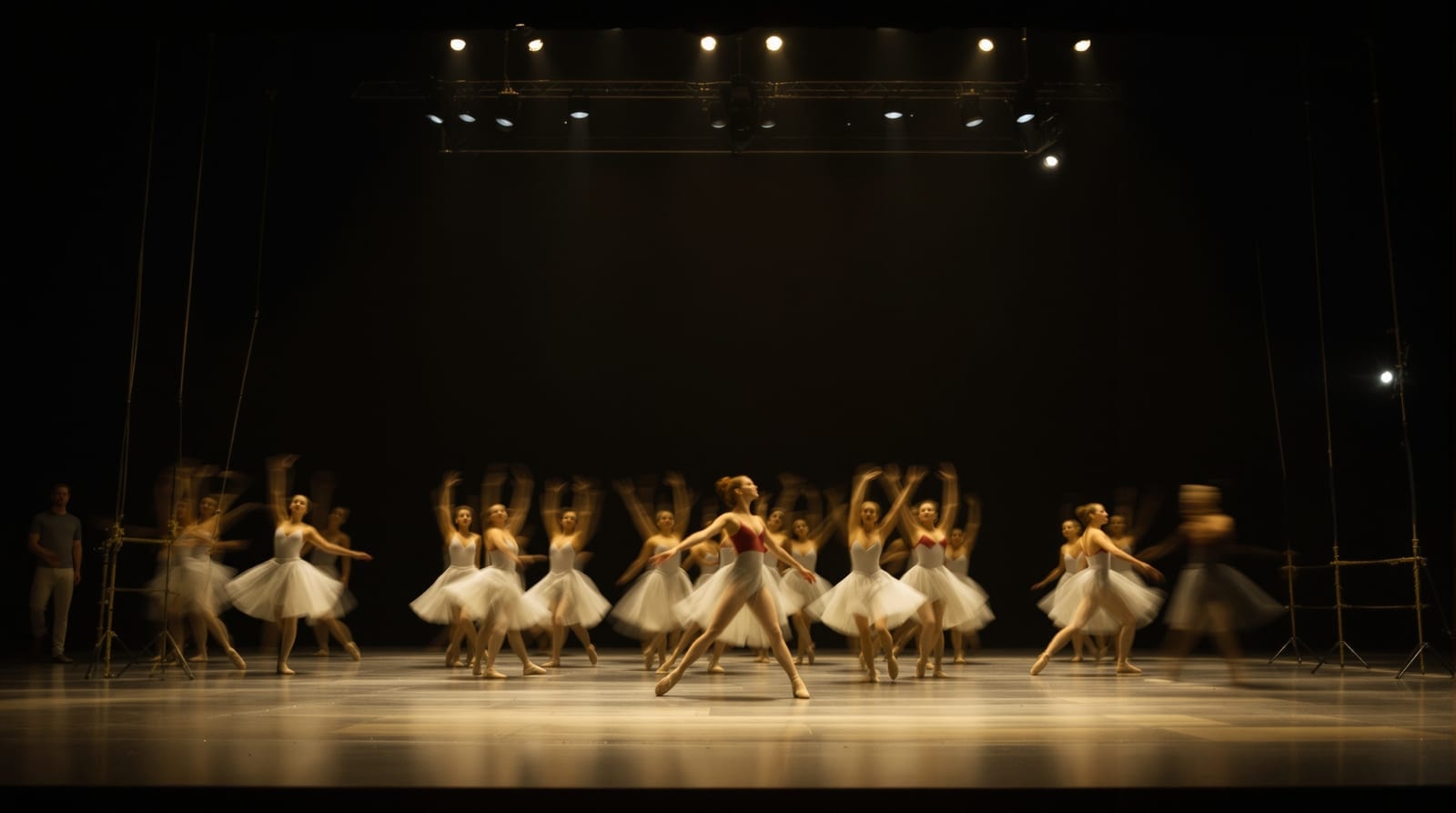
A regional ballet company’s year has a shape, and it is not the shape of a major company’s year. There is no repertory rotation and no touring schedule. There is one enormous production in December that has to work, one ambitious production in spring that gets to be interesting, a summer that belongs to the school, and a fundraiser wedged in wherever it fits. Everything else — classes, outreach, exhibitions, lecture demonstrations — runs continuously underneath.
Assembling the year
A working season had to be built backwards from its fixed points. Theatre availability established the production weeks; those weeks determined when scenery, costumes and musicians were needed; and that timetable, in turn, set the last useful date for casting and studio rehearsal. The December production occupied the firmest position because so many other commitments gathered around it. Spring work could be more flexible, but it still had to fit the venue, the rehearsal capacity and the academy calendar beneath the company’s own ambitions.
Repertoire was therefore an operational choice as well as an artistic one. A returning ballet brought known staging, usable materials and a core of remembered musical cues. A new work asked for design decisions, additional rehearsal and a longer technical conversation before it reached the stage. A mixed programme spread that risk across shorter pieces; a full-length production concentrated it. The season’s shape emerged from balancing those forms, not from placing attractive titles into empty months.
Then came the less visible assembly: securing rehearsal rooms, aligning calls with the available roster, preparing music, fitting costumes, moving production materials and leaving enough theatre time for spacing, lighting and a complete run. Publicity and printed material needed decisions before every detail was settled, while alterations continued inside the studio. One postponed task pressed directly on the next. Seen this way, a season was not a list of performances but a chain of dependencies, with the academy, company and production operation sharing the same limited calendar.
A documented year: 2014–2015
One season is documented in nearly complete detail, and it makes a good specimen.
The company schedule ran from early September 2014 to late May 2015 — roughly nine months of contracted work for the dancers, with the summer left to the school. Three things sat on it.
December: the 56th Annual Nutcracker, three performances across a weekend at the Warner Theatre, with the Lake Erie Ballet Orchestra under Maestro Hugh Keelan. The programme drew in dancers from Point Park University in Pittsburgh and from Mercyhurst University’s dance department in Erie itself. Counting the production as the fifty-sixth places the first at 1958 or 1959, two or three years after the civic company was founded — which is about right for how long it takes a new company to get a full-length Nutcracker onto a stage.
Spring: an independent-series fundraiser under the title Beyond Ballet, using both the senior and junior companies. It was described as a preview of an ongoing series of new works built around live music, dance and multimedia, staged as a social evening with food and drink rather than a proscenium performance. This is the standard regional solution to a real problem: new work does not sell tickets, but new work presented as a party does, and the party subsidises the choreography.
May: The Wizard of Oz, three performances at the Warner Theatre, an original full-length ballet by the company’s artistic director. The score was assembled from the 1939 Harold Arlen and E.Y. Harburg songs together with Herbert Stothart’s underscore, orchestrated and played live — the company’s literature described it as the first performance of that material in Erie. Putting a full student body and both companies into a story ballet everyone in the audience already knows is the other classic regional strategy: it does what the Nutcracker does, in a month when the Nutcracker is not available.
The summer block
Summer belonged to the academy, and the recorded 2015 sequence is tightly packed. A summer term ran from mid-June to early August. Observation week and an open house followed immediately, giving parents and prospective families a look at classes in progress. A Summer Ballet Intensive occupied the following week. Then came Celebrate Erie, the city’s large downtown festival, where the company performed as part of the civic programme rather than as a ticketed event. Registration for the next season opened across the whole of August and overlapped everything else.
The logic is worth spelling out. Observation week converts current students into returning students. The open house converts visitors into trial students. The intensive brings in dancers from other studios who might transfer. The festival puts the company in front of thousands of people who would never buy a ballet ticket. And registration is open through all of it. A month that looks like a lull is actually the company’s main recruitment engine.
Repertoire across the years
The documented repertoire is a mix of the expected and the unexpected. Alongside the annual Nutcracker sit full-length story ballets created for the company: Grimsby: The Great Lakes Sea Serpent in 2002, an original children’s ballet built on a local lake legend; a Cinderella staged with the Erie Playhouse under a licence the company described as unique of its type; Beauty and the Beast, Peter and the Wolf and The Little Mermaid; and, at the other end of the range, a gothic multimedia Dracula staged with a visiting Ohio company in the studio rather than the theatre.
Concert works and gala pieces came and went with each artistic director, which is the usual pattern — a director arrives, restages what they know, and the repertoire tilts for a few years. What stays constant across every recorded season is the December fixture and the three-term academy calendar underneath it.
Reading a season honestly
Season announcements are marketing documents and should be read as such. A listed production is a plan, not a performance; a “TBA” on a season sheet often means a fundraiser that did not find a date. What is verifiable here is the structure — September to May contract, December Nutcracker with orchestra, spring full-length, summer school block — and the structure repeats across every season for which anything survives. Individual dates should be treated as intentions unless corroborated elsewhere; no independent corroboration is offered.
For the venue’s own history, the Warner Theatre in Erie is a 1931 movie palace on the National Register of Historic Places and is documented there under its own listing.