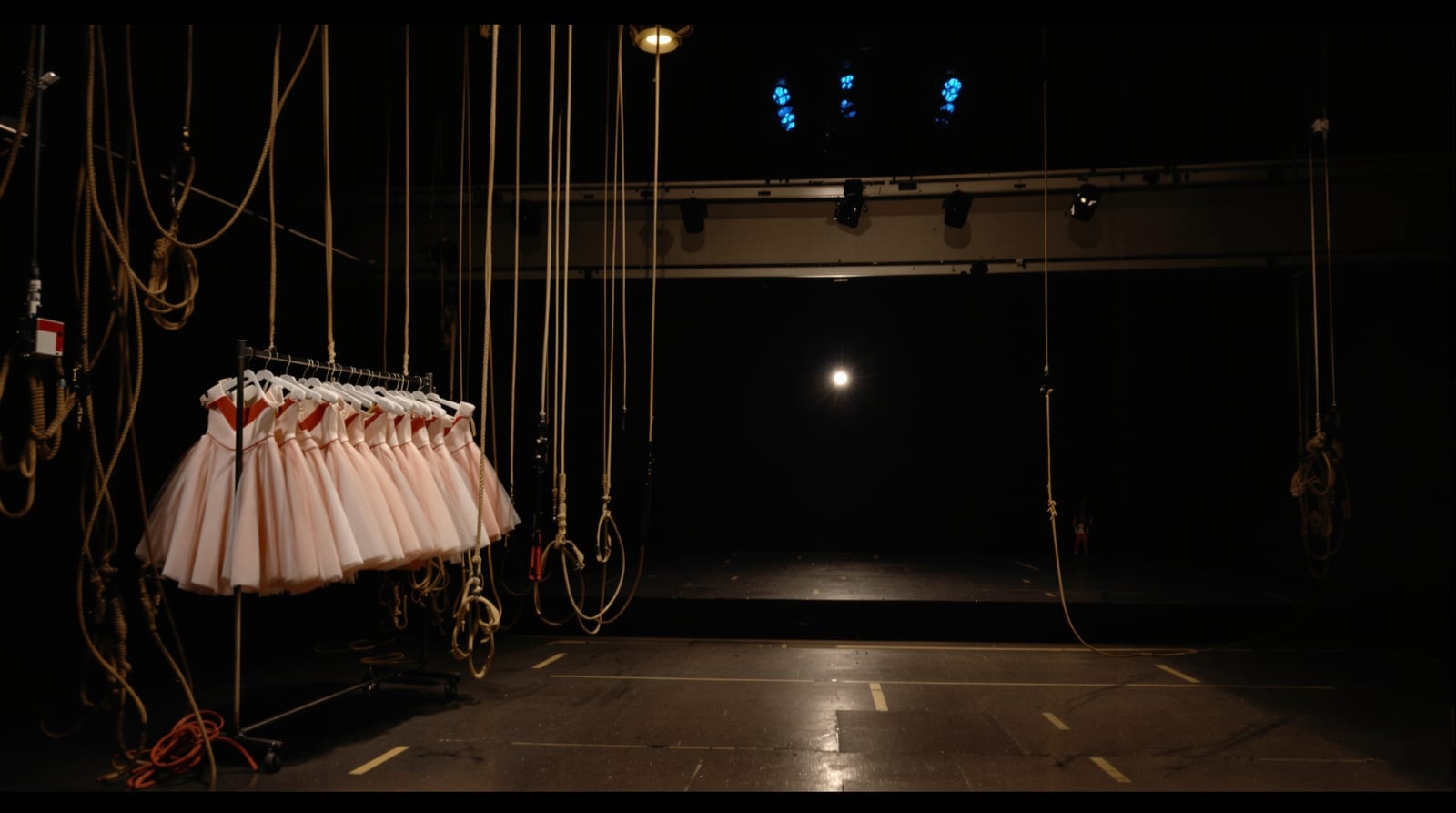
The week before a regional Nutcracker opens is the most tightly scheduled week in the company’s year, and one production schedule documents the week in enough detail to walk through it. It is an unglamorous document and it is the single most illuminating thing in the record, because it shows what the production actually consists of once the poster is stripped away.
The shape of the week
Monday and Tuesday stayed in the company’s own studios. Wednesday moved to the theatre. The rest of the week belonged to the stage, and the performances followed at the weekend.
A studio day ran roughly from mid-afternoon to half past eight in the evening, structured around a warm-up class and then scene calls in sequence. A recorded Monday, for instance, put the snow ensemble and the flutes in from two until four, ran a warm-up class from four until quarter past five, then took the party scene entire, then the dream scene with the small battle and the dolls, then the battle with everyone. Tuesday repeated the pattern with different scenes: warm-up class, then Mother Ginger and the angel scene, then the snow ensemble with the principals and the reindeer, then the finale and apotheosis, then the second-act divertissements — Chinese, Spanish, Arabian — from half past seven to half past eight.
The sequence behind the schedule
The order of theatre week followed the production’s dependencies. A stage had to be loaded and made safe before spacing could begin. Spacing had to establish entrances, exits and traffic before lighting could be judged accurately. Music, scene changes and costume transitions then had to join that framework, followed by the uninterrupted run that tested whether the pieces held together. A rehearsal called too early could only discover that another department was not ready; called too late, it left no room to correct what it found.
Each stage of the week narrowed the kind of change still available. In the studio, a passage could be rebuilt. At the first theatre call, pathways and formations could be widened or compressed. Once lighting cues and scene shifts were attached, even a small choreographic alteration might affect several other sequences. By the dress rehearsal, the useful corrections were usually concrete and local: an entrance prepared sooner, a prop cleared differently, a quick change begun on an earlier musical phrase.
The schedule was therefore also a map of authority. Rehearsal direction governed the movement in the room; stage management joined that movement to a clock; technical departments controlled what could happen safely in the space; wardrobe tracked the costume sequence; and the orchestra added another fixed set of calls. Information had to pass between those functions without stopping the run for every adjustment. The operational achievement of the week was not merely completing all the listed hours. It was turning separate working plans into one repeatable performance before the first curtain.
The warm-up class is not optional
Notice that a full technique class sits inside a rehearsal day that already runs six hours. It is not a warm-up in the casual sense. A dancer who rehearses cold is a dancer who gets injured, and a corps of largely young dancers rehearsing a jumping-heavy ballet in December, in a cold building, is a specific risk. The schedule also carried an explicit exemption — students who had already taken a technique class earlier in the day were called later — which shows the class was understood as a physical requirement rather than a formality.
The two-cast problem
Several calls in the recorded schedule are marked “both casts”. Most regional Nutcrackers double-cast the principal and featured roles, for three reasons: it protects the production against injury, it spreads the opportunity across the school, and it sells more tickets, because two casts means two sets of families.
The cost is arithmetic. Every scene involving a double-cast role has to be rehearsed twice, on a stage that is available for a limited number of hours, and the corps has to dance it both times. This is why theatre-week schedules look so dense: much of the density is repetition, not content.
Moving to the theatre
Wednesday is the hinge. The company left the studio, where the floor is sprung and familiar and the mirrors tell you where you are, and moved onto a raked or unfamiliar stage with different sightlines, different spacing and no mirrors at all. Everything the dancers have learned about where to stand becomes approximate at exactly the moment the technical departments arrive.
The recorded Wednesday split the company by act — some called to the theatre by six for the first act, others by half past seven for the second — which is how a company keeps a hundred-odd dancers from sitting in a cold auditorium for four hours. Managing that crowd is a large part of what a production staff does during Nutcracker week, and it is almost entirely invisible from the front.
The supporting documents
The schedule was distributed as a printable PDF and was revised during the week itself — the available copy carries a revision date part-way through December, which tells you the plan changed at least once. Alongside it went a separate document of Nutcracker rules: the conduct expectations for a cast largely made up of children, covering call times, backstage behaviour, costume handling and parental responsibilities. Those two documents together, rather than any artistic statement, are what actually holds a production of this kind together.
Why the schedule matters
Dance history tends to record choreography and personnel and to discard logistics, with the result that the labour involved in staging a ballet disappears from the record almost immediately. A rehearsal schedule is a primary source about work: how many hours, in what order, for whom. Such a schedule makes the labour of production concrete.
For the artistic and historical side of the same production, see the Nutcracker; for the orchestra that made the week considerably more complicated, the music page; and for the training that made a hundred-strong cast possible in the first place, the academy.
Readers interested in how dancers’ working conditions are handled in the professional sector can consult the US Department of Labor Wage and Hour Division, which sets the framework within which unpaid and volunteer participation in non-profit productions has to be arranged.