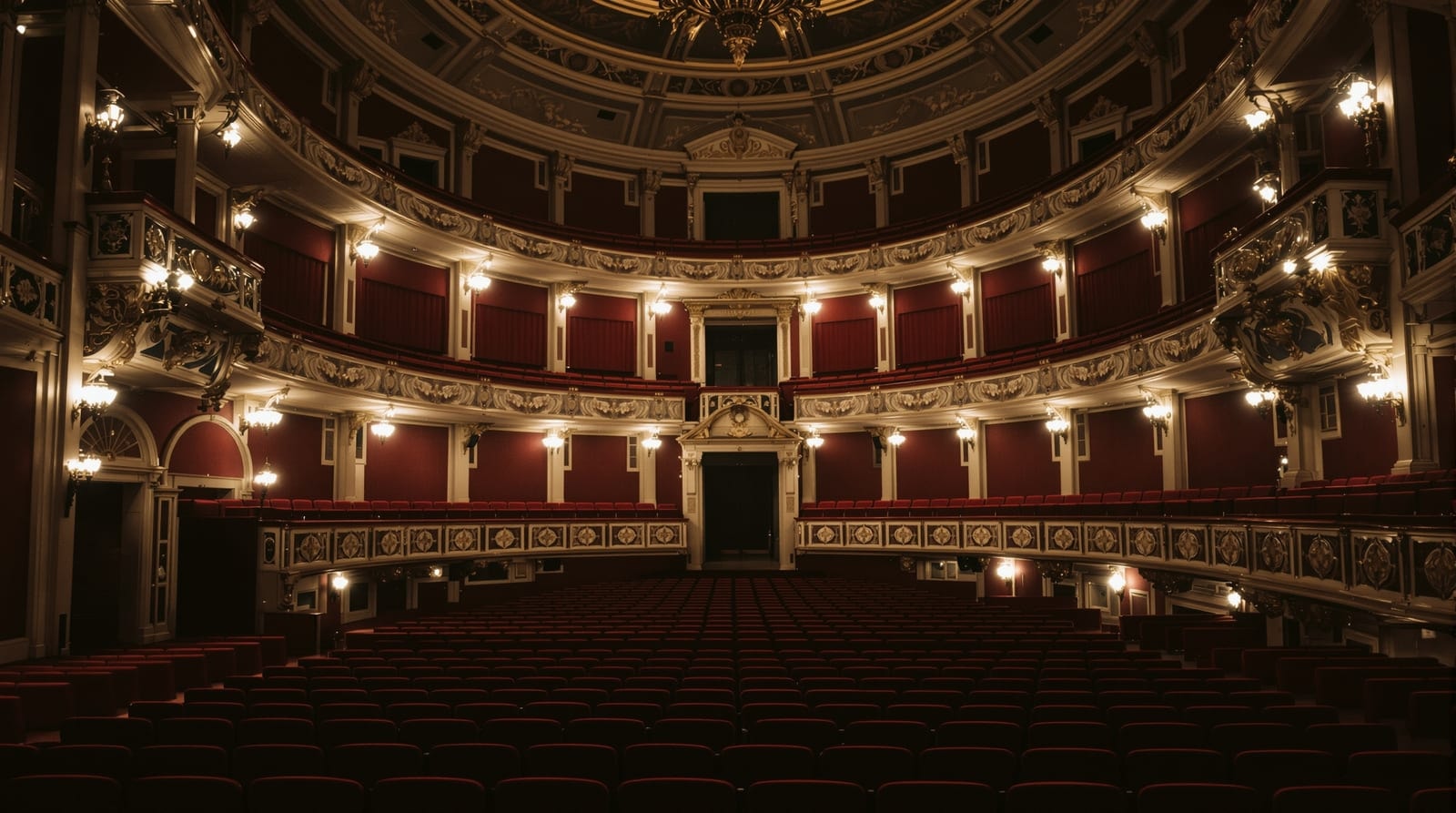
In December 2014 the company staged what its own literature called the first autism-friendly Nutcracker at the Warner Theatre, produced with the graduate special-education programme at a nearby university through its institute of applied behavioural studies. It is the best-documented single piece of programming in the company’s history, and it is worth setting out in full because the design decisions are specific and were clearly made by people who knew what they were doing.
What was changed
The performance was not simply a normal performance with a relaxed door policy. Six distinct modifications are recorded.
House lights were kept brighter than usual. A dark auditorium removes the ability to see an exit, a companion or a hand, and for many autistic audience members that is the single most disabling feature of a theatre.
Performance volume was kept softer than usual. A ballet score played by a live orchestra in a 1931 movie palace is loud, and the dynamic range is enormous. Compressing it downwards costs the performance some of its impact and removes the main reason a person might have to leave.
Scripts and narration were added to aid comprehension of a story told entirely through movement. This is the most interesting choice on the list. Ballet mime is a closed vocabulary that audiences learn by exposure; adding spoken narration does not simplify the ballet, it makes the ballet legible to somebody encountering it for the first time.
A visual schedule allowed audience members to track the chronology of the event — arrival, seating, first act, interval, second act, end. Uncertainty about duration and sequence is a common source of distress, and a printed sequence removes it entirely.
Adaptive methods were provided for ordering and paying at the souvenir and concession stands. This one is easy to overlook and matters enormously. A theatre trip is not only the performance; it is the queue, the transaction and the choosing. Building an accessible route through those makes the outing complete rather than partial.
The programme was abbreviated and ran without the full orchestra. A shorter running time is often the difference between an experience someone enjoys and one they endure.
The educational wrapper
The university did not stop at the performance. It supported the development of lesson objectives and corresponding lesson plans that regional educators could use to prepare students before the show and follow up afterwards. The whole event was framed as an “arts-enhanced community-based instruction” activity — that is, as a piece of the curriculum rather than as a day out.
This framing is what makes the project unusual. A relaxed performance treats access as a matter of removing barriers. A community-based instruction activity treats the theatre trip as a thing worth learning how to do, with the ballet as the content and the outing as the skill. Both are legitimate; the second is much rarer and much more work.
Why it was needed
The company’s own statement of the problem was plain: children with special learning needs do not always get a chance to enjoy community art, music and dance performances. That is an access problem, not a preference problem. Sensory-friendly performances have since become reasonably common in American regional theatres and museums, but in 2014 a company of this size building one from scratch with a university partner was ahead of the practice, not following it.
A note on how this page is written
This public programme ran more than a decade ago at an organisation that no longer operates. This page is not advice, and nothing on it describes anything available today. Families looking for current sensory-friendly performances should approach venues directly; most large American theatres now list relaxed performances in their access programming.
For general information about autism, the Eunice Kennedy Shriver National Institute of Child Health and Human Development maintains plain-language material, and the Centers for Disease Control and Prevention publish the standard prevalence and screening information. Neither organisation is connected to this site or to the programme described on this page.
The wider presentation apparatus around the December production is documented on how the Nutcracker was presented, and the production itself on the Nutcracker page.