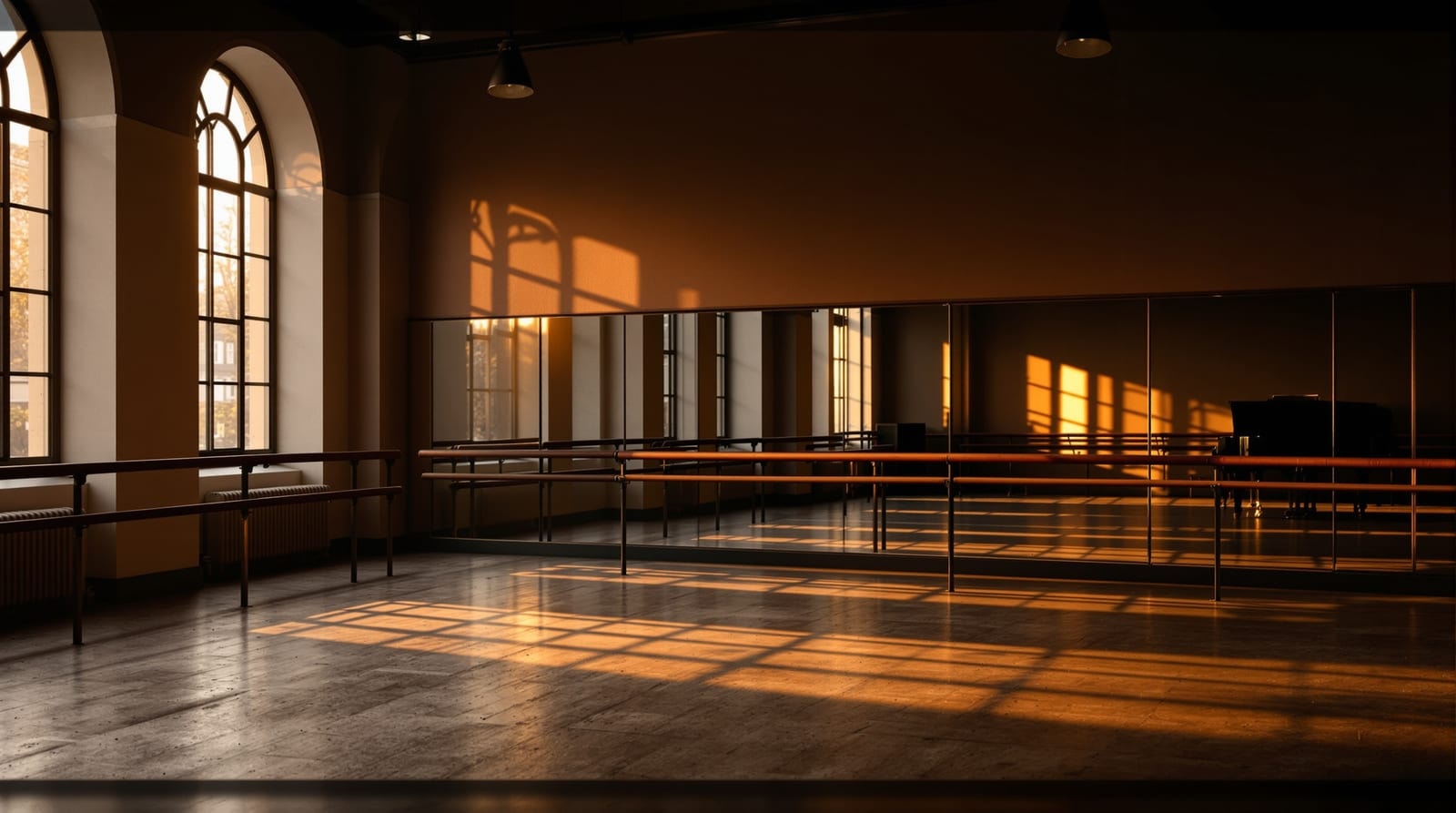
The company’s school was called the Lake Erie Academy of Dance, and it took students from the age of two and a half upwards. Its curriculum documentation is more complete than any other part of the company’s history, which is fortunate, because a written syllabus is exactly the sort of document that normally vanishes. What follows is a summary of the training model as the academy described it.
Two divisions
The programme split at age seven. The Children’s Division covered roughly ages two and a half to seven and was conducted, in the academy’s own words, to the standards of the National Dance Education Organization while keeping a classical-ballet focus. That combination is deliberate and slightly unusual. NDEO standards are built around age-appropriate movement education — what a five-year-old body should be asked to do, and what it should not — while a classical focus keeps the vocabulary consistent with what comes later. Running both together means the youngest children are not doing watered-down adult ballet, but they are also not doing something they will have to unlearn.
The Student Division covered ages seven to seventeen. Here classical ballet was the spine, with jazz, contemporary and tap taught alongside it. The academy’s stated reasoning was precise: the other forms differentiate movement vocabulary, broaden what a dancer can do, develop different muscle groups and refine coordination — but everything is taught from the perspective of an approach to classical ballet. In other words, the supplementary genres are there to make better ballet dancers, not to hedge across styles.
Three terms, three outcomes
The year ran in three blocks of ten to sixteen weeks: September to December, January to May, and June to August. Each block ended in a full-length production or a public presentation. Nothing else about the academy’s design explains as much as this does.
A term that ends in a performance is a term with a deadline, an audience and a consequence. It converts abstract technical progress into something a nine-year-old can understand and a parent can see. It also means the school and the company are structurally the same organisation rather than two things sharing a building: the autumn term ends in the Nutcracker, the spring term ends in the spring production, and the summer term ends in a presentation.
Assessment
Each term, students received a progress report from their primary instructor. At that point parents and guardians were permitted to observe classes and assess progress for themselves — a fixed observation window rather than an open-door policy, which is standard and sensible: a room of small children behaves differently when parents are watching.
At the end of each term students were tested and evaluated for advancement. Two features of the academy’s stated policy deserve attention. First, performance was encouraged but not mandatory for advancement, except for students on the Company Track. Second, advancement was granted “ultimately by the Director”. Both matter. Ballet training is one of the few fields where a child can be held at a level for a year for reasons of physical readiness that have nothing to do with effort, and a school that puts that decision in one named office is a school that has thought about who carries the consequences of it.
The Company Track
Students enrolled in the Company Track could audition for and be contracted with the company itself, giving them regular contact with the artists in residence. This is the pathway that separates a pre-professional academy from a recreational studio, and it is the reason the annual Nutcracker could field a large cast at a consistent standard: the senior students were not guests in the production, they were part of the company’s structure.
Dress code
The published class uniform was specific to the level and, in the way of the classical tradition, to gender. Children’s Division girls wore a black or pink leotard — camisole, tank, cap, short or long sleeve, but no strap designs — with pink tights, pink canvas or leather ballet slippers, and hair neatly back from the face, a bun preferred. Boys wore black leggings or tights, a plain white t-shirt with no decals, black slippers and short or neatly tied-back hair. In the Student Division the leotard was black, convertible tights were preferred, and the hair requirement tightened to a single or double bun or a french twist. Performance dress was separate again: seamed mesh tights, split-sole leather slippers, a black wrap skirt.
A dress code at this level of detail is not fussiness. A teacher needs to see the line of a leg and the placement of a hip from across a room, and a room in which everybody looks the same is a room in which the teacher can see the one person who is doing it differently. It also removes clothing as a subject of competition among children, which is a quieter but real benefit.
Fees, assistance and the honest bit
Tuition was payable in full at the start of a term with a five per cent discount, or in four monthly instalments, with late fees and a charge for returned payments. Fees were non-refundable except in cases of serious injury or illness. That last clause is the humane exception in an otherwise firm policy and is worth noting.
Financial assistance and work-trade agreements were available to students and families demonstrating need, assessed on need, ability and attitude, with applications due a month before the term. Costuming for productions was largely provided by the organisation as part of its mission, with students reserving a costume for a minimal fee; the youngest children were sometimes asked to buy theirs.
Ballet is expensive, and a regional academy that does not have a functioning assistance scheme becomes, quite quickly, a school for the children of people who can afford it. The documented existence of both bursaries and work-trade — families paying in labour rather than money — is one of the more telling details in the company’s history.
Extra training
Resident guest artists ran workshops every eight to ten weeks, open to any student wanting to augment their training, and private instruction could be arranged with any instructor or artist in residence. Guest-artist workshops at that frequency are unusually regular for a company of this size; they are the mechanism by which a student in a small city gets exposure to teaching from outside their own building.
The National Dance Education Organization publishes the standards the Children’s Division was conducted under, and remains the reference point for age-appropriate dance education in the United States.
Related pages: the teaching faculty and what they were expected to hold to, and how training, performance and outreach fitted together.