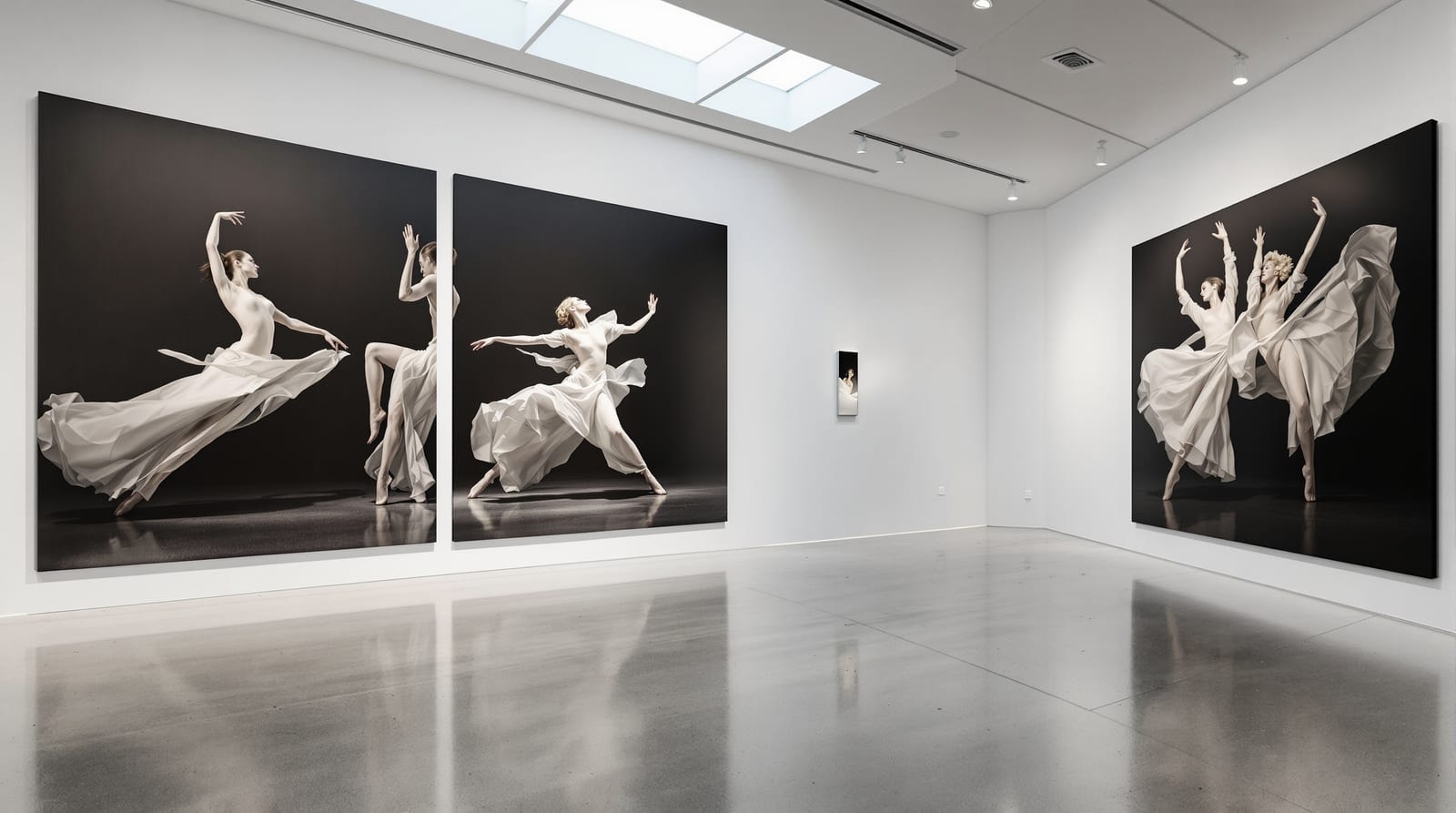
Dance is the art form least well served by its own documentation. A painting survives as itself; a symphony survives as a score; a ballet survives as a memory, a photograph of one instant, and possibly a video shot from the back of a theatre. The company’s visual programme included production photography, commissioned imagery and ArtMOVES.
ArtMOVES
The company ran an exhibition strand under the name ArtMOVES, with recorded editions in 2010 and 2014. The name and its capitalisation suggest what it was: art that moves, and art that moves you — a presentation format sitting between an exhibition and a performance.
Programmes of this kind, common in the regional arts sector, typically pair dancers with visual artists and photographers so that each shapes the other’s work: dancers posed or performing within an installation, images made in the studio and shown as a gallery exhibition, sometimes a live element within the gallery itself. For a ballet company the appeal is direct. It reaches a gallery-going audience that does not buy dance tickets, it costs a fraction of a theatre production, and it produces a durable object — an image — where a performance produces nothing.
The company also listed exhibitions alongside lecture demonstrations and residencies among its outreach formats, which places ArtMOVES firmly in the outreach tier documented on the programmes page rather than in the performance tier.
Photography and the company
Historical material shows the company working with named photographers and crediting them properly, which is more than many organisations of its size managed. Photographic credit lines appear across company material, and at least one external site linked directly to a company image with a photo-credit anchor — a small indication that the photography was good enough for other people to want to use.
Dance photography is a genuine specialism. It requires the photographer to know the repertoire well enough to anticipate the top of a jump, to work in stage light that no meter is happy with, and to understand which instant of a phrase reads as the movement and which reads as an accident. A company that has a working relationship with a photographer who understands ballet ends up with a usable archive. A company that does not ends up with a folder of blurred arabesques.
What survives, and what does not
This is the part worth being plain about. No photographs of the company’s productions are published here.
Three reasons. First, copyright in the images belongs to the photographers who made them, not to the organisation that commissioned them and certainly not to this site. Second, a great deal of the photography is of students — recitals, class photographs and Nutcracker casts — and no images of children are published here under any circumstances. Third, the company’s former video and gallery images are no longer publicly available.
The interpretive illustrations depict no identifiable person and are not documentary evidence or photographs of the company.
Where the real images are
The photographic record of an organisation like this survives in five places, none of them online.
The photographers’ own files. Working photographers keep their negatives and their drives. Where they are still active, they hold the best surviving material by a wide margin.
Family collections. Every child who danced in a Nutcracker has a photograph of it in a box somewhere. Collectively this is the largest surviving body of images and the least likely to be gathered.
The local newspaper morgue. Regional papers photographed the December production most years, and press photographs are usually well captioned and dated, which family snapshots are not.
The theatre. Venues keep production files, house programmes and sometimes archival video of what has played on their stage.
Programme books. The single most information-dense surviving artefact, as noted on the presentation page — cast, staff, sponsors and photographs in one document.
A note on preservation
If you hold photographs, video or programme material from this company, the useful thing to do with it is to give it to an institution that will keep it. County historical societies and university special collections take exactly this class of regional performing-arts material, and the National Archives preservation guidance is a reliable free introduction to handling and storing photographic material safely in the meantime.
This site is not collecting and has no way to receive anything. It carries no contact channel of any kind — see about Lake Erie Ballet.