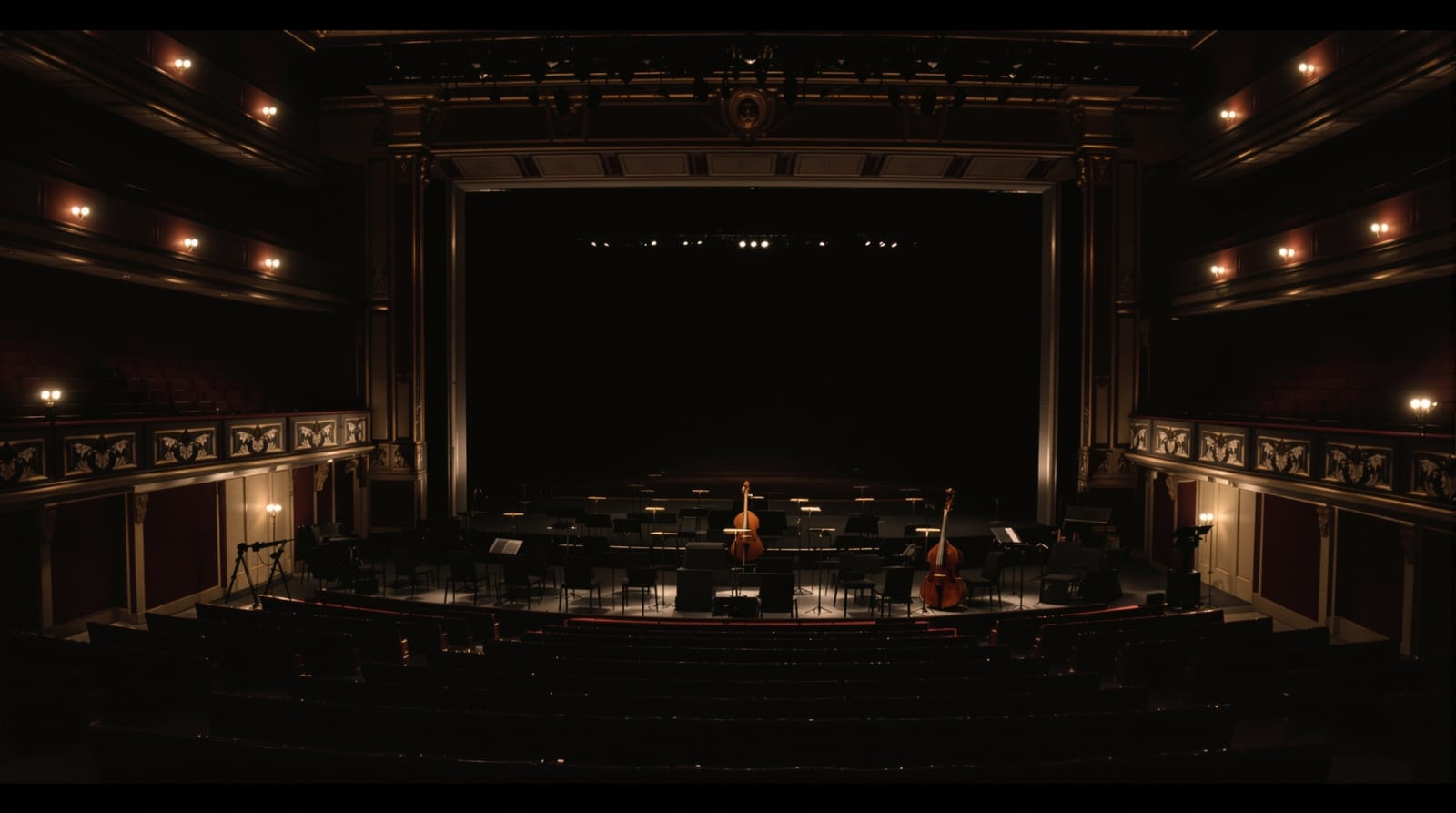
The company maintained its own orchestra and engaged a conductor for its annual Nutcracker. For an organisation of its size in the 2010s, that was an expensive and slightly stubborn decision, and it is one of the things about this company most worth recording.
What a live orchestra costs and what it buys
A pit orchestra for a full-length ballet is thirty to sixty players, a conductor, rehearsal time, parts hire and a larger venue contract. Against a recording, the cost difference at this scale is not marginal — it can be the single largest line in a production budget after the theatre itself.
What it buys is not simply better sound. It buys elasticity. A recorded score is fixed: the tempo is whatever it was on the day of the recording, and the dancers must fit themselves to it. A conductor watches the stage. When a dancer is late off a preparation, the tempo can wait a fraction of a second. When a variation is going well, it can move. In the second act of a Nutcracker — a sequence of short character dances with wildly different demands — that flexibility is the difference between a performance and a synchronisation exercise.
It also changes the dancers. A corps that has only ever danced to a recording learns to count. A corps that dances to an orchestra learns to listen, which is a different and better skill, and the one that transfers when they go elsewhere.
Rehearsing a living score
The difference began before the audience heard a note. Studio rehearsals could use a recording to establish counts and broad tempo, but that version was only a map. Once the orchestra entered, introductions breathed differently, repeated phrases acquired slightly different weight and a pause could have shape instead of a fixed number of seconds. Dancers had to recognise instrumental colour as a cue and hear where a phrase was going, rather than wait for the identical sound they had memorised.
Orchestra calls were too costly to use for ordinary cleaning, so stage time had to answer precise questions. The conductor needed to see entrances and landings; the dancers needed to test balances, transitions and the length of held positions; the pit and stage management needed agreement about where a cue began. A note made after one run could alter the next without changing the choreography at all. Rehearsal became a negotiation between movement and score, carried through gesture, timing and repeated attention.
In performance, that preparation created a shared margin for variation. An entrance could settle after a scene change, a crowded ensemble could find its pulse, and a final pose could complete before the sound closed around it. The orchestra did not follow every movement, and the stage did not command every tempo; both worked inside an agreed structure. That exchange is what live accompaniment changed most. It made each performance an act of coordination in the present, while preserving the musical architecture on which the production depended.
The conductors
The recorded conductors span the company’s history. Among the earlier names is Walter Hendl, a figure of genuine national standing — associate conductor of the New York Philharmonic, music director of the Dallas Symphony, and later director of the Eastman School of Music — who spent a substantial part of his career in this corner of Pennsylvania and New York. Bruce Morton Wright is also recorded among the earlier conductors.
In the last documented decade the podium belonged to Maestro Hugh Keelan. He came to the company having been music director of the Erie Philharmonic, and before that fifteen years as music director of the Northeastern Pennsylvania Philharmonic. His documented background includes: born in Kingston-upon-Thames, a pianist from the age of eight and later a violist; he conducted Beethoven’s Emperor Concerto in the Great Hall of the Moscow Conservatory at sixteen; read music at Cambridge with Robin Holloway, graduating with a double first and a Harkness Fellowship that took him to Indiana University and the Mannes College to study conducting; worked at the American Opera Center at the Juilliard School; and held guest engagements with the Saint Louis Symphony, La Fenice in Venice, the New Zealand Symphony Orchestra and the Residentie Orchestra of The Hague. He is also known as an arranger, notably for orchestrations of Harry Burleigh’s spirituals commissioned by the Burleigh Society — Burleigh being an Erie native and one of the most important figures in the history of American concert music.
A ballet company in a city of a hundred thousand people, engaging a conductor with that record for its December production, is not a company with modest ambitions.
The orchestra itself
The company’s orchestra was a named ensemble with a defined roster: principal and section players by instrument — strings, woodwind including doubling positions, brass, harp, percussion. It was assembled from the region’s professional freelance pool, which in this part of Pennsylvania overlaps heavily with the Erie Philharmonic, the university music departments and the wider western-Pennsylvania and eastern-Ohio circuit.
The personnel list is not included. Those were private individuals engaged as freelancers, so the staffing roster is not included on this unaffiliated site.
What is worth recording is the structure: a doubling flute, a bass clarinet, a principal harp. Those are not incidental. Tchaikovsky’s score for The Nutcracker is famously demanding in its colouring — the celesta in the Sugar Plum Fairy’s variation, the harp in the Waltz of the Flowers, the bass clarinet doubling — and a pit that carries those positions is a pit playing the actual score rather than a reduction.
Original scores and assembled scores
Not every production used a standard ballet score. The company’s Wizard of Oz was danced to the 1939 Harold Arlen and E.Y. Harburg songs together with Herbert Stothart’s underscore, orchestrated for the pit and played live — described in the company’s own literature as the first performance of that material in Erie. At the other extreme, the company’s Dracula used rock, pop and industrial music with video imaging, in a studio rather than a theatre, with no pit at all.
Between a live symphonic Tchaikovsky, a live arranged film score and an amplified contemporary soundtrack, the company covered essentially the whole range of what ballet music can be. That is unusual, and it is a consequence of the artistic-director turnover documented on the leadership page.
Context
The economics that made live accompaniment rare are not a matter of taste. The League of American Orchestras documents the pressures on regional orchestras over the same decades, and they are the same pressures — declining subscription bases, rising fixed costs, shrinking public funding — that pushed dance companies towards recordings. For Tchaikovsky’s score itself, the Britannica entry gives the standard account of its composition and instrumentation.
Related: the Nutcracker and the production week the orchestra had to be fitted into.