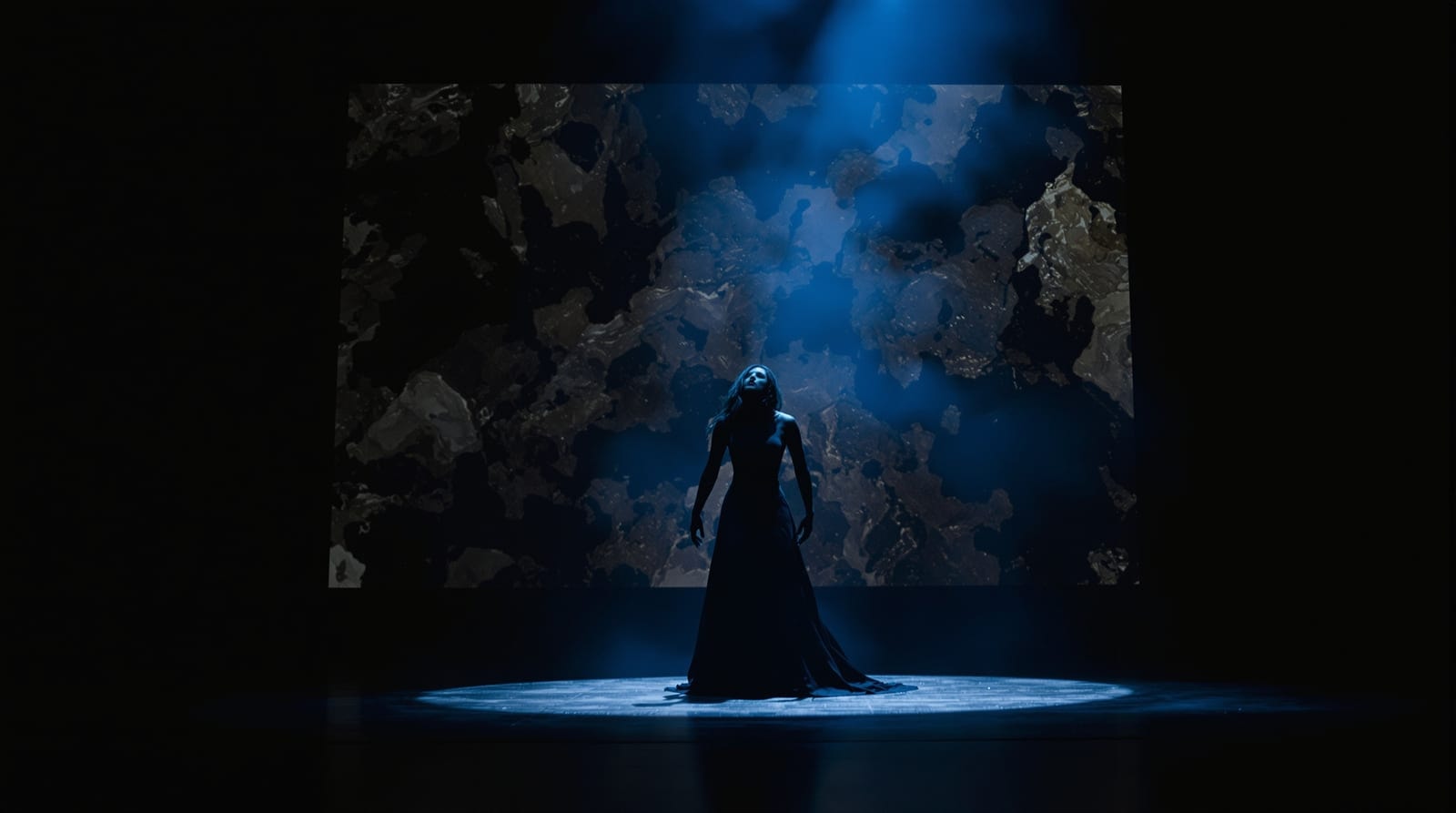
Of everything this company staged, Count… The Legend of Dracula is the production that least resembles what people expect from a regional ballet, and it is the one documented most completely. It ran for six performances across two autumn weekends, in the company’s own studio space rather than at the theatre, in a co-production with a visiting Ohio company.
The production
The work was an original adaptation of Bram Stoker’s novel, brought to Erie in collaboration with Neos Dance Theatre of Mansfield, Ohio, and its director Robert Wesner. Three artists are credited with the piece as it existed: Bobby Wesner as choreographer, Andy Gardner as videographer and documentary director, and Michael Thomas as writer — the latter two both Emmy award winners.
The company described it as a thriller and a multimedia event: video imaging and staging combined with a score drawing on rock, pop and industrial music. Performances began at eight in the evening with doors at a quarter past seven; the second Saturday carried an after-party with live music. The production was licensed by the Renaissance Performing Arts Association.
The company’s own framing of what it was doing was unambiguous. Presenting Neos Dance Theatre’s video-driven staging in Erie was described as marking a new era of innovative performance experiences. That is a statement of intent from a company that had spent sixty years mostly doing Tchaikovsky.
Why the studio and not the theatre
Staging a production in your own building rather than in the historic theatre downtown is a decision with several motives, and for a work like this most of them point the same way.
A studio is cheap. There is no rental, no stagehand call, no box-office split, so a six-performance run becomes affordable in a way that six performances at a movie palace never could be. A studio is also small, and a gothic horror piece built on projection, atmosphere and proximity gains from an audience that is close enough to be uncomfortable. Video-driven work in particular is far easier to light and focus in a controlled black-box space than in a 1931 auditorium designed for a proscenium and a pit.
And a six-performance run is itself the point. A regional company’s productions are usually two or three performances of a large ballet. Six performances of a smaller work in your own space is a fundamentally different model — closer to how a contemporary theatre company operates — and it lets a piece find an audience by word of mouth over two weekends instead of living or dying on one Saturday night.
Why Dracula, and why it works as a ballet
Stoker’s novel has been adapted for dance many times, and the reason is structural rather than fashionable. The story is built from set pieces that are already choreographic: a journey, a seduction, a party interrupted, a chase, a graveyard, a transformation. Its central relationships are physical and largely wordless. Its antagonist moves in a way no ordinary body moves, which is a gift to a choreographer.
It is also, bluntly, a ballet that sells in October. A regional company with a December fixture and a May full-length has a gap in the autumn, and a gothic piece placed in the last week of October and the first of November fills it with something an audience will turn out for. The full narrative as the company staged it is set out on the synopsis page.
The collaboration model
What makes this production interesting institutionally is that Erie did not commission a new work; it imported one. Neos Dance Theatre had the piece, the video assets and the choreography. The Erie company supplied a space, an audience, its own dancers and the production apparatus.
Co-production of this kind is how small companies get access to work they could never originate. Commissioning a full multimedia narrative ballet from scratch is beyond the budget of almost every regional company in the country; sharing one that already exists is not. The trade-off is authorship — the piece belongs to its originators, the licence is finite, and the production leaves when the run ends.
A note on the record
The press release for this production named an executive contact and a direct telephone extension, as press releases do. Those operational details are omitted from this historical account.
Neos Dance Theatre, the Ohio company that brought the production to Erie, was and is a separate organisation with no connection to this site. Its web domain has since lapsed, but that is not evidence that the organisation has stopped working. For the source novel, the full text of Stoker’s Dracula is in the public domain at Project Gutenberg.