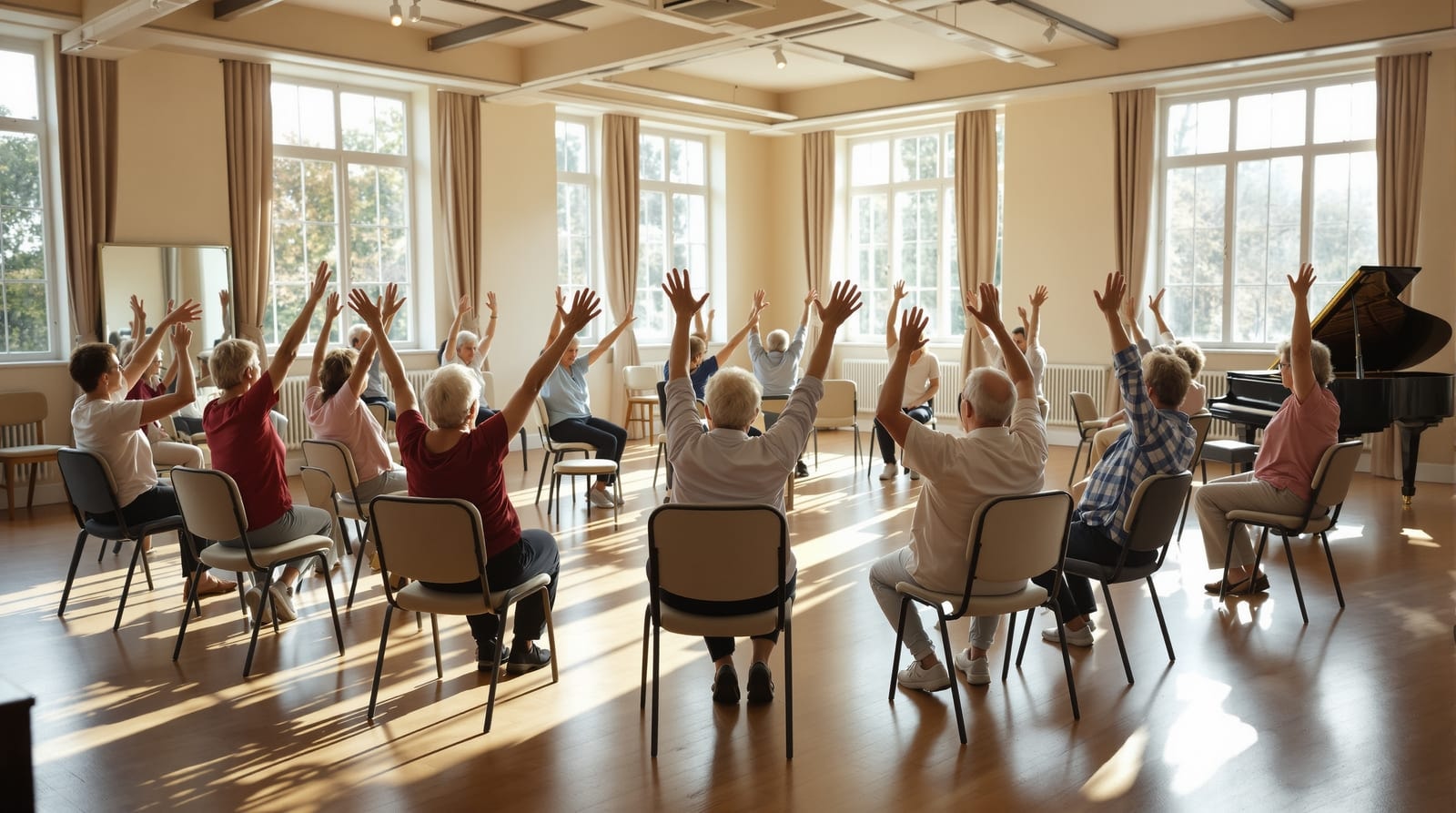
The company ran a Dance for PD class for people with Parkinson’s disease as part of its outreach programming. It is the clearest documented example of the arts-in-medicine strand, and the company’s own page about it was unusually careful — it explained the model, credited its originators and cited published research rather than making claims of its own.
The model
Dance for PD is a programme developed by the Mark Morris Dance Group in collaboration with the Brooklyn Parkinson Group, a chapter of what was then the National Parkinson Foundation. It has run at the Mark Morris Dance Center in Brooklyn since 2001.
Its founding premise is a single sentence and a good one: professionally trained dancers are movement experts whose knowledge is useful to people with Parkinson’s. Dancers spend their working lives on exactly the problems the condition presents — initiating movement, maintaining balance, sustaining rhythm, stretching and strengthening, holding a sequence in mind while executing it. The programme takes that expertise and applies it directly, with dancers rather than clinicians leading the room.
What a class involved
The company’s description of its class follows the Brooklyn model closely. Sessions were open to anyone with Parkinson’s regardless of how advanced the condition was, and no dance experience was required. Participants worked in chairs, at a barre or moving across the floor, according to what they could do on the day.
The material drew on modern dance, ballet, tap, folk and social dancing, and on the Mark Morris company’s own repertory — not simplified exercise, but actual dance. Live music accompanied the class, which is a defining feature of the format rather than a decoration: live accompaniment can follow the room, slow down, wait, and give a rhythmic cue at the moment somebody needs one, none of which a recording can do.
The atmosphere was described as non-pressured and social. That, too, is deliberate. A great deal of what Parkinson’s takes away is social rather than physical, and a class that people attend together, with their partners and carers welcome, addresses both.
The research the company cited
The company reproduced the abstract of a study published in Frontiers in Aging Neuroscience in October 2011 (Volume 3, Article 14) examining a weekly dance class modelled on the Brooklyn programme.
The study followed eleven people with moderate to severe Parkinson’s, aged between 58 and 85, taught in a ballet studio by a professional dancer. It assessed motor function immediately before and after a class using the motor section of the Unified Parkinson’s Disease Rating Scale, the Timed Up and Go test and the Semitandem test, and assessed quality of life over eight months of weekly participation using a quality-of-life scale and a further questionnaire, with a separate instrument for carers.
The reported findings were a significant short-term improvement in the total motor score immediately after class, with the strongest effects on rigidity, followed by hand movements, finger taps and facial expression. No significant change was reported on the Timed Up and Go or Semitandem measures. The questionnaires reported positive effects on social life, health, body-feeling, mobility and everyday competence for participants, and a beneficial effect for carers as well.
How to read that
The company cited a study whose small size limits what it can support. Eleven participants is a very small sample. There was no control group. The immediate post-class motor improvement is a short-term measurement, not evidence of disease modification, and two of the three motor measures showed no change at all.
What the study is reasonable evidence for is that a weekly dance class was enjoyable, socially valuable and associated with a measurable short-term improvement in some motor scores for the people who took part. That is a worthwhile thing for a ballet company to have offered. It is not a treatment claim, the company did not make one, and nothing on this page should be read as one.
Scale and reach
At the time the company was writing, classes modelled on the programme ran in more than forty communities across the United States, Canada, Italy, India, Israel, the United Kingdom and Germany. The programme has grown substantially since. It is one of the more successful examples of an arts organisation building something that other arts organisations could adopt wholesale — the Brooklyn group published its methodology and trained teachers rather than keeping the model proprietary, which is why a company in a small Pennsylvania city could run a credible version of it.
Current information
This class ran more than a decade ago at an organisation that no longer operates. This page is not medical advice and nothing described here is available today.
Anyone looking for current information should go to the sources directly. Dance for PD maintains a directory of active classes worldwide. The Parkinson’s Foundation and the National Institute of Neurological Disorders and Stroke publish reliable general information about the condition. Decisions about exercise should be made with a clinician who knows the individual case. None of these organisations is connected to this site.