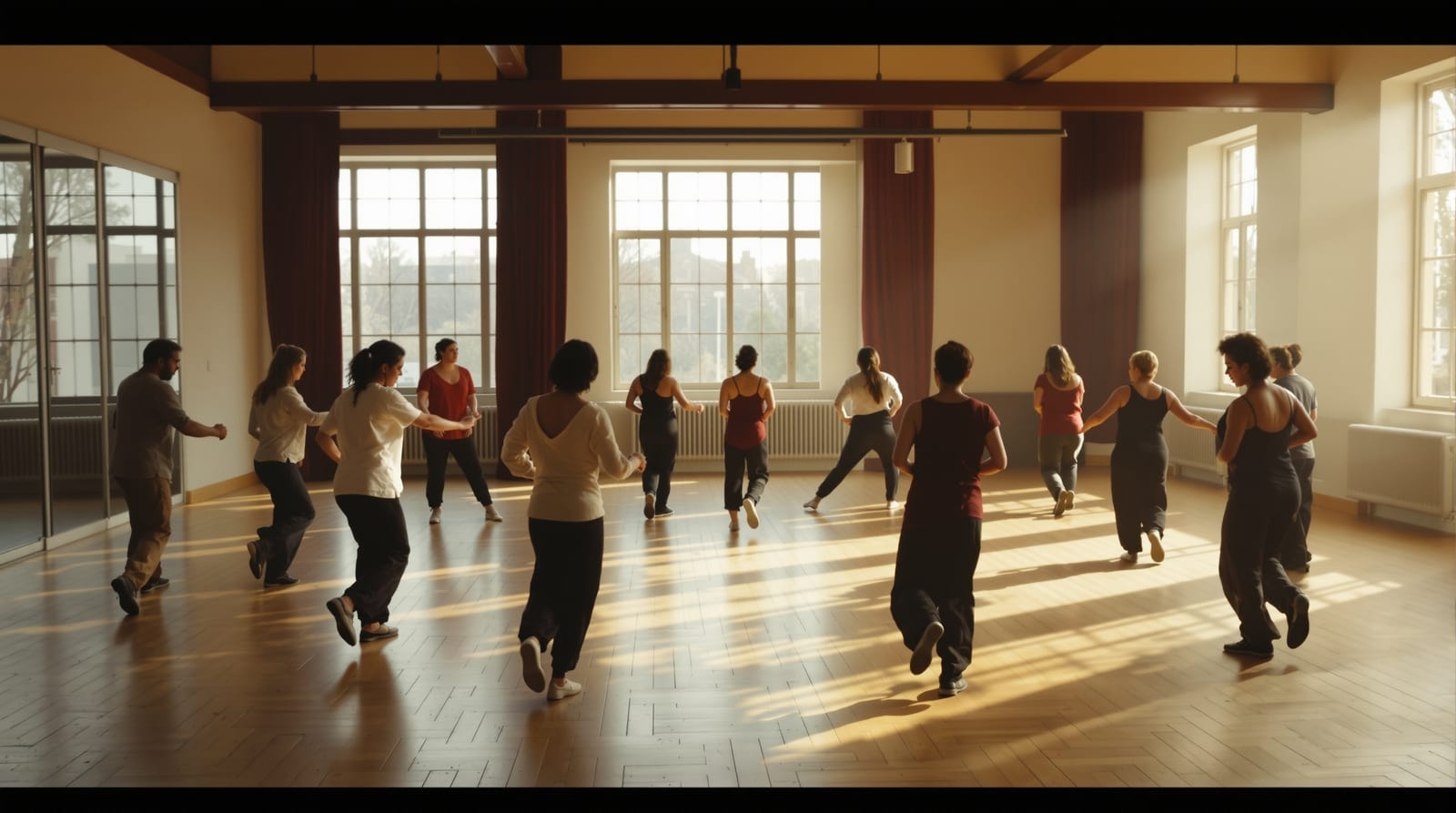
The company described its programming as three-tiered — training, performance and outreach — and insisted that each tier was integral to the others. That claim is easy to write into a mission statement and hard to actually build. In this case the record shows the connective tissue, so it is worth taking seriously.
How the tiers interlock
The company’s own explanation was concrete rather than aspirational. The collective of artists who worked most closely with the performing companies also taught within the school. The dancers and guest artists who performed with the companies also carried the arts-in-education and arts-in-medicine work. One roster of people, three functions.
That arrangement is partly economic — a small organisation cannot afford three separate staffs — but the artistic consequence is real. A student in the academy is taught by someone they will later watch perform. An outreach session in a school is delivered by a working dancer rather than by an education officer. And a company member spends part of every week teaching, which is the fastest way for a dancer to understand their own technique.
The programme as a circuit
The three strands were designed as a circuit rather than a hierarchy. Studio work supplied a shared vocabulary and kept technique under regular scrutiny. Performance gave that vocabulary a deadline, a scale and an audience. Outreach then required the same material to be made legible in a classroom, hall or other setting without scenery or theatre conventions. Each change of setting exposed a different weakness, and the next round of training could answer it. The programme joined those settings through repeated practice rather than treating them as separate departments.
This structure also allowed repertoire to travel. A phrase prepared in class could become part of a longer sequence in company rehearsal, then be reduced to a clear excerpt for a lecture demonstration. What returned to the studio was not identical. Questions from an unfamiliar audience revealed which gestures communicated without explanation, while performance showed where technique failed under pressure or at full scale. Teaching the material forced its assumptions into words. The movement passed through all three strands and gathered information at each stop.
The circulation mattered to the organisation as well as to the dancing. A single rehearsal could prepare both a stage appearance and a demonstration; a teaching session could reinforce the physical principles needed in repertory; an outreach engagement could introduce the company’s work beyond its established theatre audience. None of those exchanges removed the labour or cost of the others, but together they made one body of work serve several purposes. That is the practical meaning of the three-tier model preserved in the company’s own description.
Training
The academy served students from two and a half through to adult. Its stated staffing principle was to enlist only qualified and capable professionals both to teach and to develop the curriculum — note that the curriculum was treated as something under continuing development rather than as a fixed inheritance.
Children’s Division classes combined the National Dance Education Organization’s standards with a consistent grounding in classical ballet. Student Division classes developed technique and personal aesthetic together, with jazz, modern, contemporary and tap broadening movement vocabulary, developing different muscle groups and refining coordination — always, in the company’s framing, taught from the perspective of classical ballet. The full structure is documented on the academy page.
Performance
The company’s statement on performance is one of the company’s clearest statements: performance is an invaluable aspect of dance training for the teacher, the choreographer and the dancer alike, connecting the student with the teacher, the dancer with the artist and the audience with the dance.
Underneath the rhetoric is a practical structure. The organisation offered several tiers of performing opportunity across a season, from novice through to professional, and made choreographic opportunities available as well. A dancer could progress from a school presentation to the junior company to the senior company without leaving the building, and a choreographer could get a work made and shown. In a city without a second professional company, that internal ladder is the whole opportunity structure.
Outreach
The outreach tier is where the company reached furthest beyond its own audience, and it took four documented forms.
Arts in Education residencies. Dancers placed into schools for a sustained period rather than for a single visit — the difference between a demonstration and a residency being that a residency changes what the class can do.
Lecture demonstrations. The standard format for introducing an unfamiliar audience to ballet: a dancer, a teacher, a piece of repertoire and an explanation, usually in a school hall or a community room rather than a theatre.
Exhibitions. Presentations outside the conventional performance setting, including the company’s ArtMOVES work documented on the visual record page.
Ballerina Princess Camps. Short holiday programmes for very young children. Commercially these are a reliable earner and a recruitment funnel; pedagogically they are a first contact with a studio for children who have never been in one.
Alongside these ran the arts-in-medicine strand, of which the best-documented example is the company’s Dance for Parkinson’s class.
The mission sentence, and its date problem
The company summarised itself in a single line: Erie’s premier non-profit dance organisation, providing quality dance education, unparalleled dance performances and extraordinary opportunities to dance artists compelled to create, since 1948.
That final date conflicts with the other chronology. Other material in the record dates the founding of Erie Civic Ballet to 1956, and the organisation trading in Erie today dates its lineage to 1957. The most likely explanation — a teaching practice predating the formal civic company by several years — is discussed on the history page. Both claims are noted, and neither is treated as settled.
What the model implies
A three-tier structure of this kind is not just an organisational chart; it is a funding argument. Tuition income from training subsidises performance. Performance income, overwhelmingly from the December production, subsidises outreach. Outreach generates the public-benefit case that unlocks grant funding, which flows back into all three. Break any one link and the other two become fragile — which is the standard failure mode for organisations of this size, and the reason so few of them last sixty years.
For the national picture on how arts education programmes of this type are structured and funded, the National Endowment for the Arts arts-education programme is the primary public reference.